
Can a Dude be a ‘Karen’???
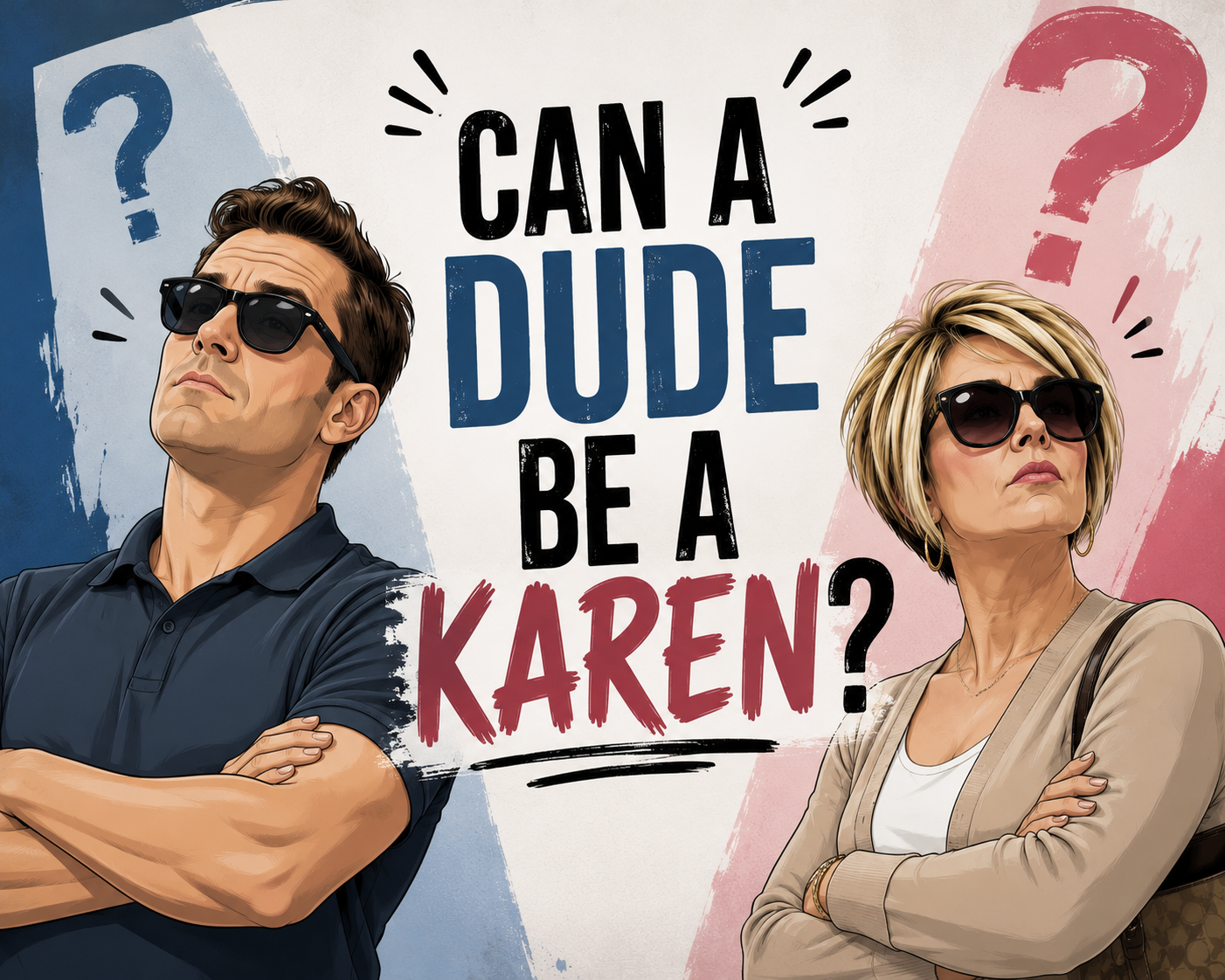
The other night, as I lay awake trying to understand a situation I am currently experiencing, a question suddenly popped into my head so clearly I actually said it out loud:
“Can a dude be a Karen?”
Short answer?
Absolutely.
But the fact that people even ask the question is actually more interesting than the answer itself.
Because somewhere along the way, “Karen” stopped meaning “difficult customer” and became something much bigger culturally.
The internet turned it into a very specific character:
Usually a middle-aged woman.
Emotionally reactive.
Demanding.
Entitled.
Confrontational.
Certain the rules do not apply to her.
Requesting to “speak to the manager.”
The haircut became symbolic.
The attitude became recognizable.
And the memes exploded.
But if we strip away the hairstyle jokes and internet humour for a second, what people are really describing when they say “Karen” is not femininity.
It is behaviour.
And men display those behaviours all the time.
The difference is that society often labels men differently when they do it.
The Male Version of a Karen
Everyone knows the guy.
The man who:
berates minimum wage employees,
throws tantrums when inconvenienced,
believes rules are beneath him,
dominates conversations aggressively,
acts personally offended by minor discomfort,
weaponizes status, intimidation, or authority,
and treats public spaces like extensions of his ego.
He exists.
We just usually call him something else.
Sometimes he is “alpha.”
Sometimes he is “assertive.”
Sometimes he is “just blunt.”
Sometimes people laugh it off because male aggression and dominance have historically been normalized in ways female aggression has not.
That double standard is worth noticing.
Because emotionally reactive entitlement is not gender-specific.
Human ego is equal opportunity.
And to be fair, both men and women can become controlling, reactive, difficult, or emotionally immature under stress, insecurity, ego, exhaustion, resentment, or unresolved pain.
The internet simply chose one version and gave it a name.
Why the “Karen” Label Became So Female-Focused
The reason the stereotype became so attached to women likely has less to do with behaviour itself and more to do with cultural expectations.
Society tends to expect women to be:
accommodating,
emotionally controlled,
pleasant,
nurturing,
socially agreeable,
and self-aware.
So when a woman becomes visibly confrontational, emotionally reactive, demanding, or publicly difficult, people notice immediately.
It violates the social script.
Men, meanwhile, have historically been given more room to:
dominate,
interrupt,
complain loudly,
express anger publicly,
or challenge others aggressively.
In some environments, those traits are even rewarded.
So when men behave in “Karen-like” ways, the behaviour often blends into what society already expects from difficult men.
The Internet Loves Caricatures
The internet also thrives on recognizable archetypes.
And “Karen” became one of the most successful online caricatures of the modern era because people instantly understood the image:
the sunglasses,
the haircut,
the crossed arms,
the outrage,
the superiority,
the demand to escalate everything.
It became shorthand for entitlement itself.
But like most internet labels, the term eventually expanded beyond its original meaning.
Now people use “Karen” to describe:
anyone who complains,
anyone who disagrees loudly,
anyone enforcing rules,
anyone perceived as uptight,
or simply anyone people find annoying.
At that point, the term becomes less about accountability and more about social mockery.
And that is usually where nuance dies online.
Entitlement Has No Gender
Truthfully, the deeper issue underneath “Karen culture” is not women.
It is entitlement.
It is emotional immaturity.
It is low frustration tolerance.
It is the belief that personal discomfort justifies public disrespect.
It is the inability to regulate emotions without making everyone else responsible for them.
That can appear in:
women,
men,
teenagers,
executives,
customers,
politicians,
influencers,
and honestly… sometimes all of us on bad days.
The internet just packaged one version into a meme.
Why People Are Fascinated by Karens
I think part of society’s obsession with “Karen culture” comes from the fact that it represents behaviours people deeply dislike but secretly recognize.
Nobody wants to be viewed as:
unreasonable,
arrogant,
emotionally unstable,
difficult,
self-important,
or incapable of handling discomfort maturely.
So people mock “Karens” partly because it creates distance.
“At least I’m not that person.”
But human beings are complicated.
Most emotionally reactive people are not walking around thinking:
“I am unreasonable.”
Usually they feel:
unheard,
powerless,
embarrassed,
overstimulated,
disrespected,
emotionally overwhelmed,
or unable to regulate what they are feeling in the moment.
That does not excuse bad behaviour.
But understanding behaviour and excusing behaviour are not the same thing.
The Male Karen Exists. We Just Renamed Him.
Maybe that is the real takeaway.
The male Karen absolutely exists.
He always has.
We just normalized, rewarded, or renamed one version of entitlement while mocking another.
And perhaps that says just as much about society as it does about the people being criticized.
Because the internet rarely chooses stereotypes randomly.
It chooses the ones that expose cultural tension underneath them.
And maybe that is why the label became so culturally powerful in the first place.
Deep down, people are not just reacting to bad behaviour.
They are reacting to the uncomfortable reality that entitlement, emotional reactivity, ego, and public disrespect are not rare personality flaws belonging to “other people.”
They are deeply human tendencies.
The internet simply gave one version a haircut and a name.