We Are More Than This Existence
There is a way of seeing the human being that exists outside of anatomy, psychology, or even traditional religion.
A way of seeing ourselves not as flesh first — but as energy first.
Not the body.
Not the personality.
Not the identity we spend years constructing around ourselves.
But consciousness itself.
An awareness temporarily moving through form.
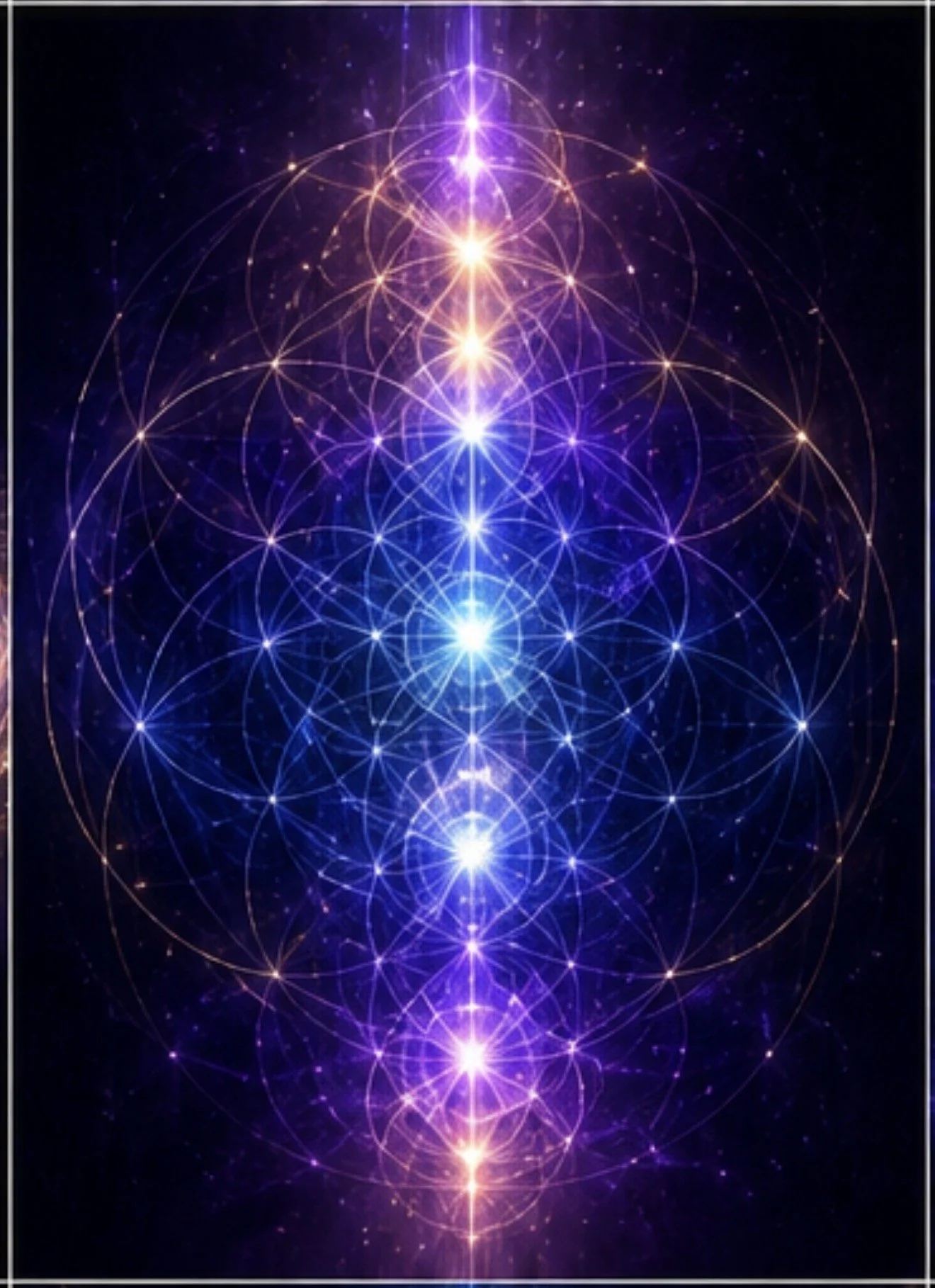
When I try to conceptualize the human soul, I do not picture organs, muscles, or structure. I picture a hollow space filled with radiant energy — crystalline light shimmering in indigo, violet, white, blue, and gold. A living field of sparkling consciousness suspended inside a temporary vessel.
Almost as though the body is not who we are, but where we are.
And strangely, this idea is not isolated to modern spirituality. Variations of it appear throughout psychology, mysticism, religion, metaphysics, and ancient philosophy across centuries of human history.
Carl Jung explored the idea of the collective unconscious — a shared layer of human consciousness existing beneath the personal self. Jung believed symbols, archetypes, dreams, and intuition connected humanity to something deeper and universal, almost as if the psyche itself extended beyond the individual mind.
In Hindu philosophy, particularly within concepts surrounding Atman and Brahman, the soul is viewed not as separate from God, but as an expression of divine consciousness itself. The physical body is temporary, while consciousness is eternal. Many yogic traditions also describe energetic systems within the human body — chakras, prana, kundalini — not visible anatomically, yet deeply felt spiritually.
Buddhist teachings often approach the self differently, suggesting the ego-identity is an illusion altogether. Suffering comes from attachment to the constructed self. Enlightenment is not becoming “more,” but dissolving the illusion of separateness and reconnecting to pure awareness.
Mystical Christianity carries similar undertones, though often hidden beneath institutional structure. Many Christian mystics described divine light within the soul — a direct inner connection to God beyond ritual or performance. The “kingdom of heaven within you” becomes less metaphorical and more experiential.
Even near-death experiences reported across cultures often describe remarkably similar imagery:
light,
energy,
expansion,
timelessness,
unconditional love,
loss of ego identity,
and a feeling of returning home rather than disappearing.
What fascinates me most is that despite enormous cultural differences, humanity repeatedly returns to the same core intuition:
We are more than the body.
Modern science itself has begun brushing against strangely philosophical territory. Quantum physics has forced conversations around observation, interconnectedness, probability fields, and the nature of consciousness itself. While spirituality and science are not interchangeable, it is interesting how often both eventually arrive at mystery.
Because the deeper humanity looks — spiritually or scientifically — the less solid reality begins to appear.
And perhaps that is why so many people feel spiritually disconnected in modern society.
We are taught to identify entirely with external structure:
our appearance,
our productivity,
our social status,
our trauma,
our labels,
our achievements,
our failures.
But very little attention is given to the possibility that underneath all of those layers exists something untouched by any of them.
A consciousness older than identity.
A quiet intelligence.
An energy.
When people describe awakening experiences, profound grief, meditation, psychedelics, prayer, deep love, or moments in nature, they often speak about the temporary dissolving of separateness. The ego quiets. Time softens. And for a moment they feel connected to something infinite.
Not above them.
Within them.
That is the part I find most beautiful.
The idea that God may not exist somewhere far away watching humanity from a distance, but rather flowing through every living thing as consciousness itself. That every human being carries a fragment of divine energy within them — sparkling quietly beneath fear, shame, ego, survival, and conditioning.
Not as punishment.
Not as hierarchy.
But as experience.
A temporary human experience wrapped around something eternal.
And maybe intuition itself is simply the soul recognizing truth before the mind can explain it.
Maybe that “pull” people feel toward beauty, love, healing, art, stars, oceans, music, or stillness is not random at all.
Maybe the soul remembers what the human forgets.
Maybe inside every person exists an infinite field of light trying to return to itself beneath all the noise of being human.
And maybe that glowing hollow space within us is not empty at all.
Maybe it is where everything truly begins…