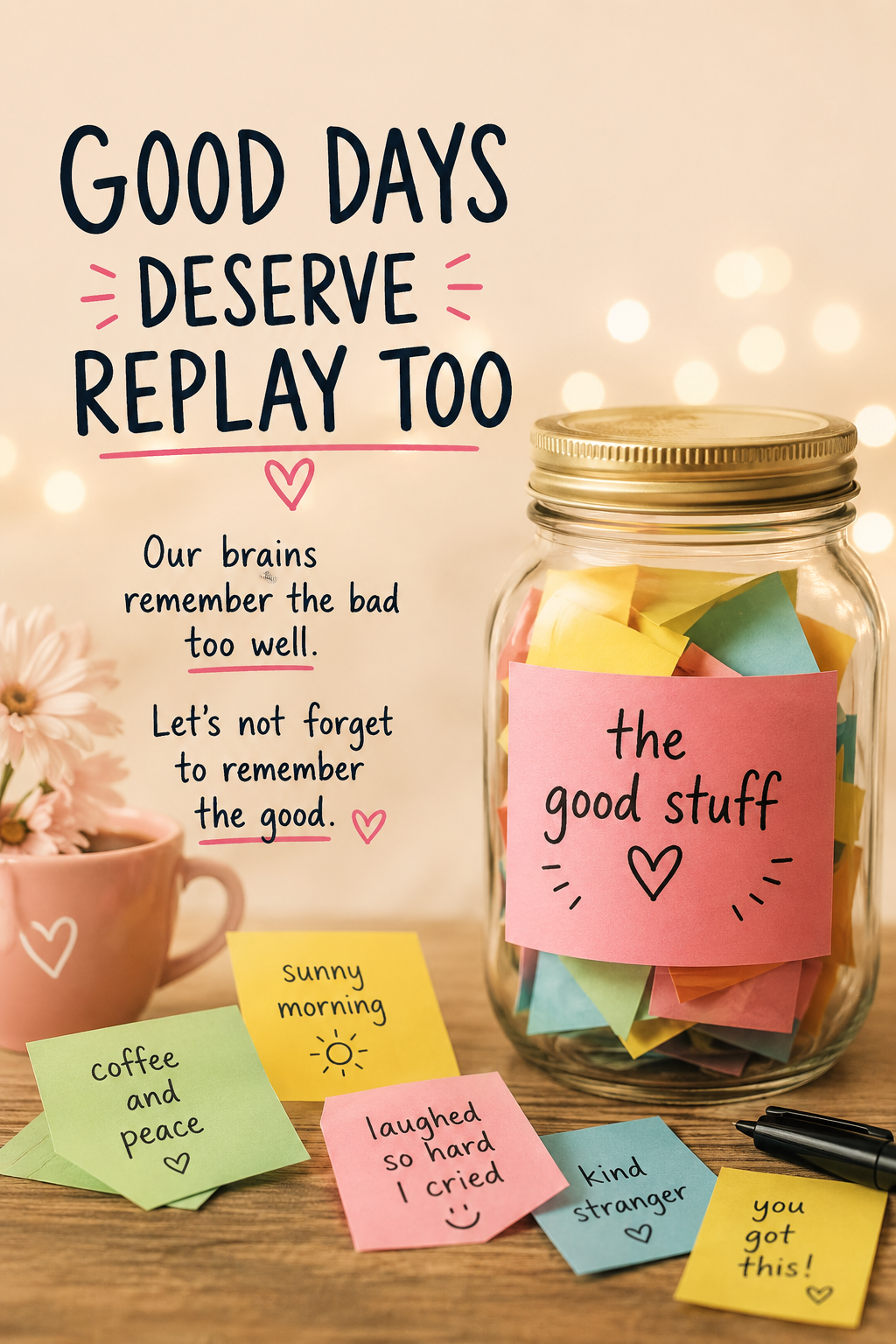
Good Days Deserve Replay Too

The Human Brain Has a Weird Obsession With Bad Memories
You could have:
the best brunch of your life,
a really good hair day,
a peaceful drive home with your favourite song playing,
three people compliment you,
your coffee made perfectly,
and an entire day that felt genuinely… good.
And then someone says one mildly rude thing at 4:37 PM and suddenly your brain is acting like the entire day was a personal attack.
Human beings are fascinating.
Our brains have a tendency to hold onto negative experiences far more tightly than positive ones. Psychologists call this negativity bias — which is really just a scientific way of saying:
“Your brain is kind of dramatic sometimes.”
But honestly, it makes sense.
Thousands of years ago, human survival depended on remembering dangerous things.
The brain did not need to strongly remember:
“Wow… that sunset was beautiful.”
It needed to remember:
“Do NOT go near the large angry animal by the river again.”
One mistake could cost you your life.
So the brain evolved to prioritize discomfort, danger, rejection, embarrassment, criticism, conflict, and emotional pain because, biologically speaking, survival was more important than peace.
Unfortunately, your nervous system does not always recognize the difference between:
being chased by a bear,
andsomebody leaving you on read.
To your physiology?
Stress is stress.
Your heart rate changes.
Your cortisol rises.
Your body becomes alert.
Your nervous system stamps the moment as:
“IMPORTANT. WE MUST THINK ABOUT THIS FOR THE NEXT NINE HOURS.”
Meanwhile, beautiful moments tend to pass through us quietly.
We rush through good things.
We barely pause when life feels nice.
A peaceful morning becomes “normal.”
A healthy relationship becomes “expected.”
A compliment gets brushed away.
A calm day goes unnoticed.
But discomfort?
Oh, the brain pulls up a chair for that.
What is interesting though, is that positive memories are not actually weaker.
We just rehearse the negative ones more often.
Humans are constantly replaying awkward conversations from 2014 while simultaneously forgetting:
how hard they once laughed with someone they loved,
the smell of fresh-cut grass in childhood summers,
the warmth of holding a sleeping baby,
late-night drives,
campfires,
kitchen dancing,
moments they once prayed for.
And I think that is a little sad.
Not devastatingly sad.
Just… unfortunate.
Because life is actually filled with small beautiful things happening all the time.
Most of them simply do not activate our nervous systems strongly enough for us to cling to them automatically.
Which means sometimes we have to participate intentionally.
We have to notice the good on purpose.
We have to stay in the moment for an extra few seconds.
We have to let compliments land.
We have to replay beautiful memories too.
We have to tell the stories that made us laugh instead of only the ones that hurt us.
Not because life is perfect.
Not because bad things do not matter.
But because if we are not careful, the human brain can accidentally turn an entire existence into a highlight reel of stress while quietly overlooking all the moments that made life worth living in the first place.
So this is your reminder:
The good memories deserve rehearsal too.
The tiny ones especially.
The ordinary Tuesday ones.
The sunlight-through-the-window ones.
The laughing-so-hard-you-snort ones.
The “I survived that season” ones.
Your nervous system may naturally cling to the negative.
But your awareness does not have to.
And honestly?
The brain could probably use a little better PR for life these days.