
All ACE’s- A Different Kind of Strength
The Childhood That Followed Me Into Adulthood
An honest reflection on adverse childhood experiences, the lives we might have lived, and the quiet grief of healing from a childhood we never chose.
Today, I walked into a hospital classroom for an educational session on sexual assault.
Ninety minutes later, I walked out.
Not because I questioned the importance of the subject. I was there as a registered nurse, surrounded by colleagues, learning how to better care for people who have experienced sexual violence.
I left because the classroom stopped feeling like a classroom.
A mention of a machete took me straight back to something involving my brother. Other words and scenarios opened doors to experiences I had endured as a child—experiences that shaped much of the woman I became.
For a while, I was no longer only the nurse in the room.
I was also the little girl who had lived through things no child should have to understand.
And suddenly, I felt terribly alone.
That moment forced me to confront more than old memories. It brought back the childhood I had survived, the adult life those experiences helped shape, and the quiet grief of wondering who I might have become if I had grown up feeling safe.
The Unfortunate Difference
I looked around the table at the women I work with—women I know, respect, and genuinely enjoy.
I thought about their lives, their families, and the different circumstances in which we grew up. I don’t know every hardship they’ve experienced; people carry private struggles that aren’t visible. But I know my own history.
For a moment, I wondered what it might have been like to grow up in a stable, loving home—one where adults were emotionally available, children felt protected, affection was dependable, and safety could be taken for granted.
Imagine that.
A childhood where being a child was your only responsibility.
I wasn’t envious or angry, and I wasn’t seeking sympathy.
I just felt unfortunate.
Tragic, even.
Not in a victim sort of way, but in the quiet realization that I experienced an extraordinary amount of adversity before I was old enough to understand what adversity meant.
And those experiences didn’t end when childhood did.
They followed me.
When Childhood Becomes an Adult’s Responsibility
I experienced sexual abuse, emotional neglect, instability, and relationships in which love and security were unreliable.
As a child, I lacked the maturity and resources to understand what was happening. So I adapted.
I learned to monitor people’s moods, anticipate rejection, watch for danger, and protect myself—often without realizing it.
What protects a child can complicate an adult’s life.
For years, I struggled with emotional regulation, especially when I felt rejected, abandoned, misunderstood, or unloved. I could go from secure to threatened in an instant.
An unanswered message became evidence that someone no longer cared. A disagreement felt like the beginning of abandonment. Withheld affection could send me into an emotional state wildly disproportionate to the situation.
I didn’t recognize the disproportion then.
The feelings were real. The fear was real. The urgency was real.
When threatened, I often fought back: with words meant to hurt, by leaving before someone could leave me, or by demanding reassurance from people who couldn’t repair the insecurity I carried inside.
Then came the regret, the apologies, and the attempts to repair relationships damaged by reactions I barely understood.
It was exhausting—for the people who loved me and for me.
I spent years living with an emotional alarm system that announced an emergency whenever someone disappointed me, without an instruction manual or an off switch.
The Cost of Surviving
Looking back, I can see how deeply those early experiences influenced my relationships, choices, and understanding of love.
I married, became a mother to three beautiful daughters, built a nursing career, loved fiercely, and worked hard to create the life I had always wanted.
But beneath those accomplishments was a woman who struggled to feel secure.
I feared abandonment, though I didn’t always recognize it. I expected people to love as deeply as I did and to offer loyalty, honesty, and reassurance. When they didn’t, I often experienced their choices as reflections of my worth.
I tried to control outcomes because uncertainty felt unbearable. I stayed in unhealthy relationships too long; at other times, I burned bridges because leaving felt safer than waiting to be left.
My life included divorce, addiction, profound emotional distress, and periods when I barely recognized myself. Some consequences were temporary. Others were life-altering.
Perhaps the most painful has been the distance between my daughters and me.
I cannot attribute every difficulty in my adult life to my childhood. I made my own choices and am responsible for them. But many were influenced by emotional patterns formed long before I understood healthy relationships.
Understanding the origin of a behaviour does not excuse its consequences. It gives us somewhere to begin changing it.
That distinction has become one of the most important lessons of my life.
Grieving the Life That Might Have Been
In that classroom, I wasn’t only remembering what happened to me as a child. I was thinking about everything that followed: the years spent struggling with emotions I couldn’t regulate, relationships I damaged while trying to preserve them, and times I mistook fear for intuition, attachment for love, and independence for rejection.
I wondered how different my life might have been if I had grown up feeling safe.
Would I have trusted people more easily? Disagreed without feeling threatened? Been less afraid of losing the people I loved? Made different decisions in my marriage, relationships, or years as a mother?
Would my daughters and I be together today?
I don’t know.
That is the cruelty of wondering what might have been: there is no answer waiting at the end.
Still, there is room to grieve that imagined life—not because we are ungrateful for the one we have, but because some suffering might have been prevented.
I have spent enormous energy learning lessons a healthier childhood might have taught me naturally:
How to trust.
How to tolerate disappointment.
How to feel safe when someone is upset with me.
How to accept that people can love me without agreeing with me.
How to let someone leave without interpreting it as proof that I am unworthy of love.
These may sound simple. For me, they have been among the hardest things I’ve ever learned.
Sometimes I wish I hadn’t needed to work so hard to learn them.
The Research Behind the Reflection
Researchers use the term adverse childhood experiences, or ACEs, to describe certain potentially harmful experiences before age eighteen, including abuse, neglect, exposure to violence, and household challenges such as substance use or instability. The original ACE study found associations between the number of reported childhood adversities and several adult health risks; it did not establish that ACEs directly caused every later outcome (Felitti et al., 1998).
Later reviews have similarly found that people reporting multiple ACEs, on average, face higher risks of some mental health difficulties, substance use, and chronic physical health conditions. These are population-level associations, not predictions about any one person. They also reflect only some forms of adversity and do not capture the full range of protective experiences, cultural contexts, or individual differences (Hughes et al., 2017).
Early, repeated stress may affect developing stress-response and regulatory systems, particularly when children lack consistent, supportive relationships. The concept of “toxic stress” is used to describe prolonged or excessive activation of stress systems without adequate buffering support, although the effects vary and are not inevitable (Shonkoff et al., 2012).
That research helps me understand my experience without reducing my life to a score or a diagnosis. A child who learns that relationships are unpredictable may become more alert to signs of rejection. A child who learns that conflict is dangerous may react defensively before determining whether a present threat exists. A child who learns that love can disappear without warning may work intensely to prevent people from leaving.
These responses can be understandable adaptations to earlier circumstances. They are not proof of permanent damage, and they do not excuse harm caused to others. They describe patterns that may be changed with awareness, support, and practice.
Research on resilience suggests that recovery is not a rare trait possessed by a few unusually strong people. It is often supported by ordinary protective systems, including reliable relationships, opportunities to develop skills, and environments that make healthy adaptation possible (Masten, 2001).
The past can influence us without having the final word.
That gives me hope.
We can learn. We can change. Sometimes, with tremendous effort and support, we can become a source of safety for ourselves while also accepting the care of others.
A Different Kind of Strength
I used to think strength meant surviving whatever life threw at me.
Now I think it also means recognizing what hurts and choosing not to endure it unnecessarily.
Today, I left the classroom.
Years ago, I might have forced myself to stay, worried about appearing weak, disappointing my employer, or explaining why the subject affected me. Instead, I recognized what was happening, spoke to my manager, and went home.
There was no dramatic breakdown or confrontation. I simply acknowledged that I had reached my emotional limit.
For someone who spent much of her life ignoring her needs while seeking reassurance from others, that is meaningful change.
I am learning that discomfort does not always require immediate action; sadness does not have to consume me; rejection, disappointment, and uncertainty are painful but not emergencies; and other people are entitled to make choices I don’t understand.
I am also learning that I can live peacefully even when people I love choose not to participate in my life.
I haven’t mastered any of this. But I am no longer willing to let every difficult emotion control my behaviour.
I’ve lived that way.
It was exhausting, and the consequences were too expensive.
And Then My Mentor Momma Told Me She Had Cancer
Later this evening, unsettled by the day, I felt compelled to call the woman who had become my mentor Mom. She had been part of my life since I was fifteen, when she, so to speak, “adopted” me, and she had undergone a breast biopsy about a week and a half earlier. I hadn’t heard the results.
When I reached her, she was teaching.
I asked whether she had received them.
She told me she had breast cancer.
After a day confronting memories of my childhood, I was suddenly facing another difficult reality involving someone who had chosen to become part of my life and had supported me through important years.
I didn’t cry or panic. Despite being a nurse, I didn’t immediately ask about staging, pathology, treatment, or prognosis.
I just felt stunned—and strangely empty.
I wanted to reassure her that everything would be okay, but I don’t know what will happen. I don’t know what treatment she’ll need or what the coming months will bring. I don’t know how to feel yet.
My relationship with my mentor mother is deeply meaningful. She entered my life when I was fifteen and became a source of guidance, care, and support. She did not give birth to me, but she became family in a way that has mattered profoundly.
Tonight, I don’t need to understand or resolve every feeling. I only need to recognize that she has cancer, that I love her, and that she won’t face what comes next without my support.
Perhaps that is enough for now.
The Children We Were, the Adults We Become
As I reflect on the day, I keep returning to the women around that classroom table.
How many were carrying memories nobody could see? How many had experienced things they had never spoken about? How many were quietly managing their histories while appearing composed?
I may never know.
I do know that I felt alone today, and sad for the little girl I once was. Perhaps even more, I felt sad for the woman who spent years struggling because of what that girl endured.
We encourage resilience so often that we sometimes overlook its cost.
We celebrate people who overcome adversity—their strength, determination, and ability to keep going. Those qualities deserve recognition.
But wouldn’t it have been wonderful if some of us hadn’t needed so much strength?
Wouldn’t it have been lovely to grow up without becoming experts at reading other people’s emotions, to enter adulthood without confusing love with fear, to build relationships without anticipating their loss, and to spend our energy discovering who we wanted to become rather than why we were hurting?
I think so.
Acknowledging that doesn’t make me bitter, ungrateful, or trapped in the past. It makes me honest.
I cannot change my childhood, reclaim the years I spent struggling, undo every mistake, or restore every relationship. But I can stop punishing myself for not knowing at twenty or thirty what it has taken me until my forties to understand.
I can hold myself accountable without treating myself with contempt. I can acknowledge the damage without deciding I am damaged beyond repair. I can grieve what I didn’t receive without letting that grief consume what I still have.
Today was difficult. I was reminded of a childhood I didn’t choose, an adulthood I struggled to navigate, relationships I wish had unfolded differently, and the frightening uncertainty of my mentor mother’s diagnosis.
I don’t have a profound lesson to offer tonight. For once, I don’t feel compelled to find one.
I simply wish some things had been different.
And I think that is a perfectly reasonable thing to wish.
I am not asking to be excused from the life I’ve lived. I am simply acknowledging how difficult it has sometimes been to live it.
There is no shame in that.
Perhaps healing is not always about finding the good in what happened. Sometimes it is about saying that what happened was unfortunate, that it mattered, and that we deserved better.
Without anger.
Without blame.
Without needing anyone else to agree.
Just the truth.
And tonight, the truth is enough.
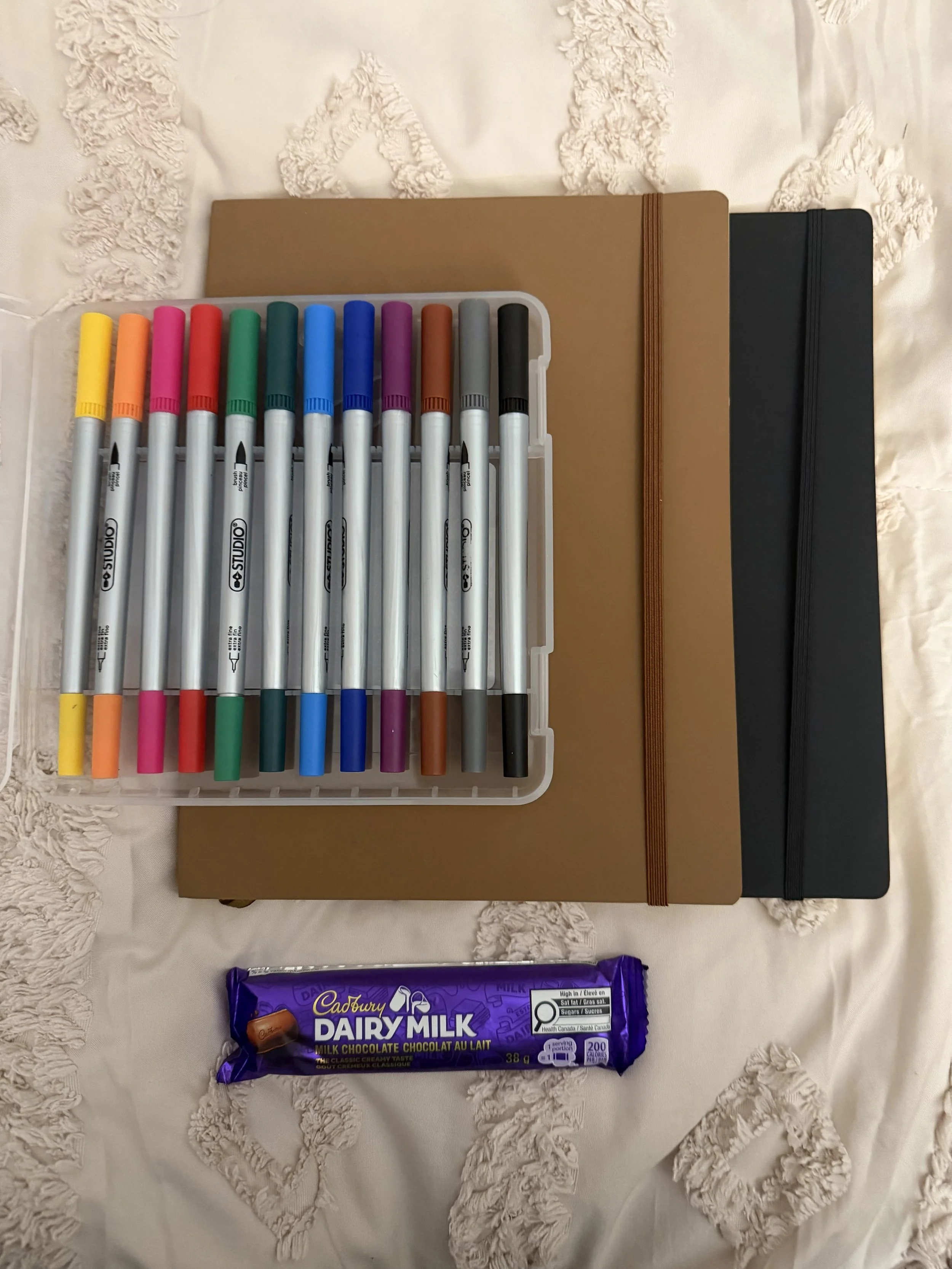
I decided to do something kind for myself… A quick visit to the local dollarama to buy myself a care pack ❤️ 2 journals (a place for my feelings), new felt markers (calligraphy style for and inner child creativity) and my favourite chocolate (tasty comfort).
Research and Further Reading
Felitti, V. J., et al. (1998). Relationship of Childhood Abuse and Household Dysfunction to Many of the Leading Causes of Death in Adults. American Journal of Preventive Medicine, 14(4), 245–258. The foundational ACE study, which identified associations between reported childhood adversity and several adult health outcomes.
Hughes, K., et al. (2017). The effect of multiple adverse childhood experiences on health: a systematic review and meta-analysis. The Lancet Public Health, 2(8), e356–e366. A review of associations between cumulative ACE exposure and later health outcomes, with important limits on causal interpretation.
Shonkoff, J. P., et al. (2012). The Lifelong Effects of Early Childhood Adversity and Toxic Stress. Pediatrics, 129(1), e232–e246. Discusses how prolonged adversity and stress may influence development and long-term health, while emphasizing the role of supportive relationships.
Masten, A. S. (2001). Ordinary Magic: Resilience Processes in Development. American Psychologist, 56(3), 227–238. Describes resilience as a developmental process supported by ordinary adaptive systems and relationships.