
Can Someone Be Manipulative Without Meaning To?
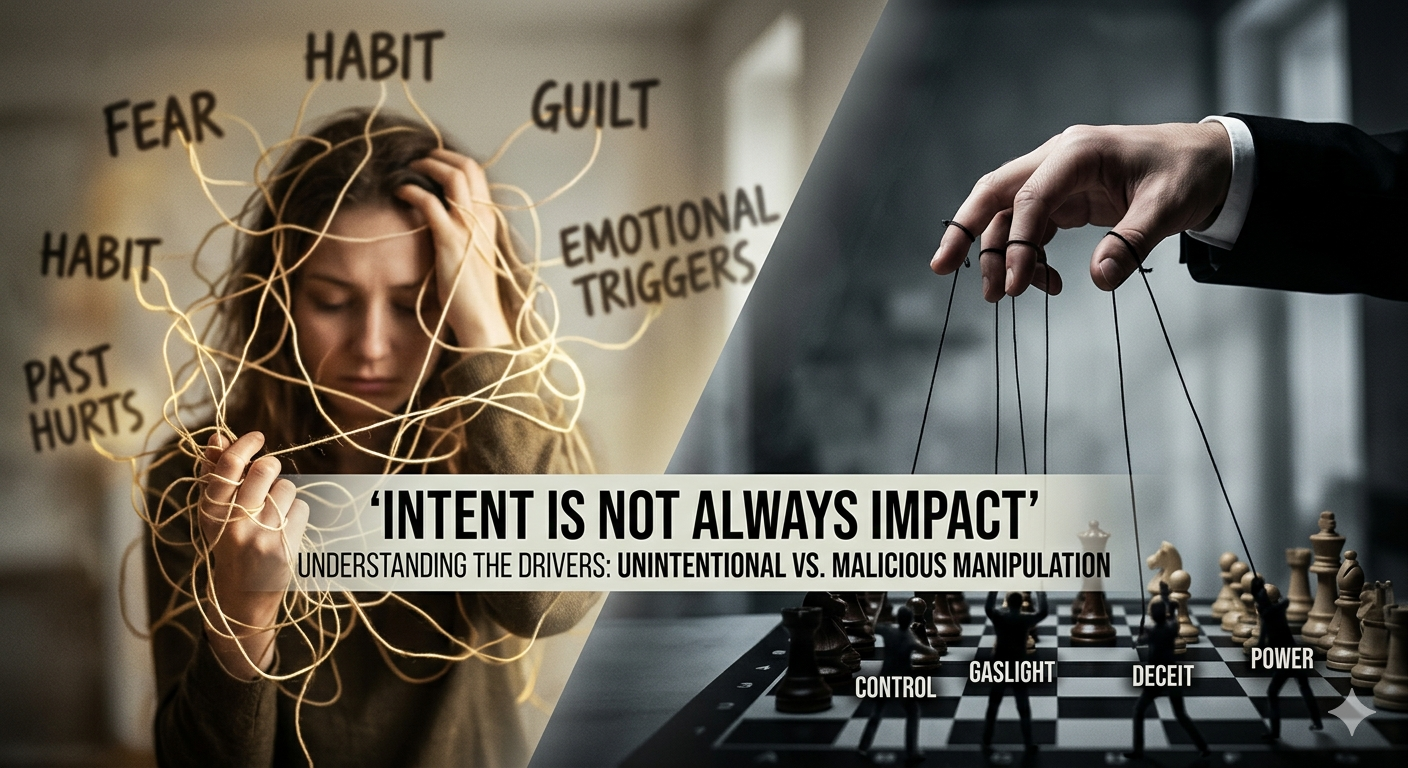
Understanding the Difference Between Unintentional and Malicious Manipulation**
Most people think manipulation is always intentional—something calculated, deliberate, even malicious.
That’s not entirely accurate.
Someone can behave in ways that feel manipulative—creating guilt, pressure, or emotional responsibility—without actively trying to control you. At the same time, there are people who are intentional about it.
The distinction matters, because it changes how you interpret the behaviour—but it doesn’t change the need for boundaries.
Unintentional Manipulation: When It’s Not a Strategy
In many cases, what looks like manipulation is actually learned behavior or emotional coping, not a conscious attempt to control someone.
Psychological research shows that a large portion of human behavior operates outside of full awareness. People often act from habit, conditioning, or emotional triggers rather than deliberate planning.
In practical terms, that means:
Someone may use guilt because it’s how they learned to get needs met
Someone may shut down or withdraw to create closeness
Someone may escalate emotionally because they don’t know how to regulate themselves
They’re not thinking, “How do I control this person?”
They’re reacting to discomfort in the only way they know how.
That doesn’t make the behavior harmless—it just means the driver is different.
Where These Patterns Come From
Unintentional manipulation usually develops over time. Common sources include:
1. Early environment
Attachment research shows that early relational environments shape how people seek closeness, express needs, and respond to emotional threat (Bowlby, 1969; Ainsworth et al., 1978).
If direct communication wasn’t safe or effective growing up, people adapt. Indirect behaviors—like guilt, emotional intensity, or withdrawal—become tools.
2. Emotional survival
Emotional dysregulation—often rooted in anxiety or fear of abandonment—can lead to behaviours that indirectly influence others (Gross, 1998).
Fear plays a big role:
fear of abandonment
fear of not being heard
fear of losing connection
These fears can push people into behaviours that influence others without conscious intent.
This isn’t about control. It’s about managing internal distress.
3. Low self-awareness
Research on self-perception and cognitive bias shows that people are often poor judges of their own motives and impact (Nisbett & Wilson, 1977).
Some people genuinely don’t see their patterns. Research on human perception shows we’re not as good as we think at understanding our own motives or the impact of our behaviour
So they may minimize, justify, or completely miss what they’re doing.
Malicious Manipulation: When It Is Intentional
On the other end of the spectrum, there is manipulation that is deliberate.
This type involves:
awareness of the behavior
a goal (control, advantage, avoidance of consequences)
willingness to distort, pressure, or exploit
In psychology, manipulation in this context is defined as intentionally influencing someone’s thoughts or actions for personal gain—often without their full awareness.
In social psychology, manipulation is often defined as intentionally influencing another person’s behaviour or perception for personal gain, sometimes through deceptive or indirect means (Buss, 1992; Braiker, 2004).
Examples include:
gaslighting (making someone question reality)
calculated guilt or blame
withholding affection to control behavior
lying or omitting information strategically
This isn’t about poor coping.
It’s about control.
The Mistake People Make: Focusing Only on Inten
Here’s where things go wrong.
People often excuse behaviour by saying:
“They don’t mean it.”
Or they assume the worst:
“They’re doing this on purpose.”
Both can be inaccurate.
Research on attribution theory shows that humans tend to misinterpret others’ intentions—either overestimating or underestimating deliberate control (Heider, 1958; Ross, 1977).
A more useful framework is:
Intent explains the behavior
Impact defines your experience
You can feel manipulated by someone who has no intention of harming you.
And you can be harmed by someone who denies any intent.
What Actually Matters in Real Life
Instead of trying to label someone as manipulative or not, look at your experience:
Do you feel guilty for setting normal boundaries?
Do you feel responsible for their emotional state?
Is it difficult to say no without consequences?
When you bring it up, do they take responsibility—or deflect?
Those answers tell you more than their intent ever will.
The Bottom Line
Some people are acting out of habit, fear, or lack of awareness.
Some people are acting with clear intent to control.
But here’s the part that doesn’t change:
Unintentional behavior can still be unhealthy.
And understanding someone doesn’t mean you tolerate everything they do.
References
Ainsworth, M. D. S., Blehar, M. C., Waters, E., & Wall, S. (1978). Patterns of Attachment: A Psychological Study of the Strange Situation.
Bargh, J. A., & Chartrand, T. L. (1999). The unbearable automaticity of being. American Psychologist, 54(7), 462–479.
Bowlby, J. (1969). Attachment and Loss: Vol. 1. Attachment.
Braiker, H. B. (2004). Who’s Pulling Your Strings? How to Break the Cycle of Manipulation.
Buss, D. M. (1992). Manipulation in close relationships: Five personality factors in interactional context. Journal of Personality, 60(2), 477–499.
Gross, J. J. (1998). The emerging field of emotion regulation: An integrative review. Review of General Psychology, 2(3), 271–299.
Heider, F. (1958). The Psychology of Interpersonal Relations.
Kahneman, D. (2011). Thinking, Fast and Slow.
Nisbett, R. E., & Wilson, T. D. (1977). Telling more than we can know. Psychological Review, 84(3), 231–259.
Ross, L. (1977). The intuitive psychologist and his shortcomings. Advances in Experimental Social Psychology, 10, 173–220.
Llllllll